Sound Forge Pro Review 2026 — Is It Still Worth It?
Sound Forge Pro just changed owners — again. If you're trying to decide whether to buy it, upgrade from an older version, or just figure out what the Boris FX acquisition actually means for the software, this review covers all of it. Short version: the core tool is unchanged and still one of the best dedicated waveform editors on Windows. The longer version is below.
If you've been a Sound Forge user for a while, your first reaction to the news was probably: wait, again? Fair. This software has changed hands more times than most people change DAWs. Sonic Foundry built it back in 1992. Sony bought it in 2003. MAGIX took it over in 2016 and shipped it through Sound Forge Pro 18. Now Boris FX owns it as of March 30, 2026 — picking it up alongside Vegas Pro and Acid Pro in a single acquisition from MAGIX Software GmbH.
Each ownership change has raised the same question. This time around, the answer is less complicated than it looks.
What Is Sound Forge Pro — and What Is It Actually For?
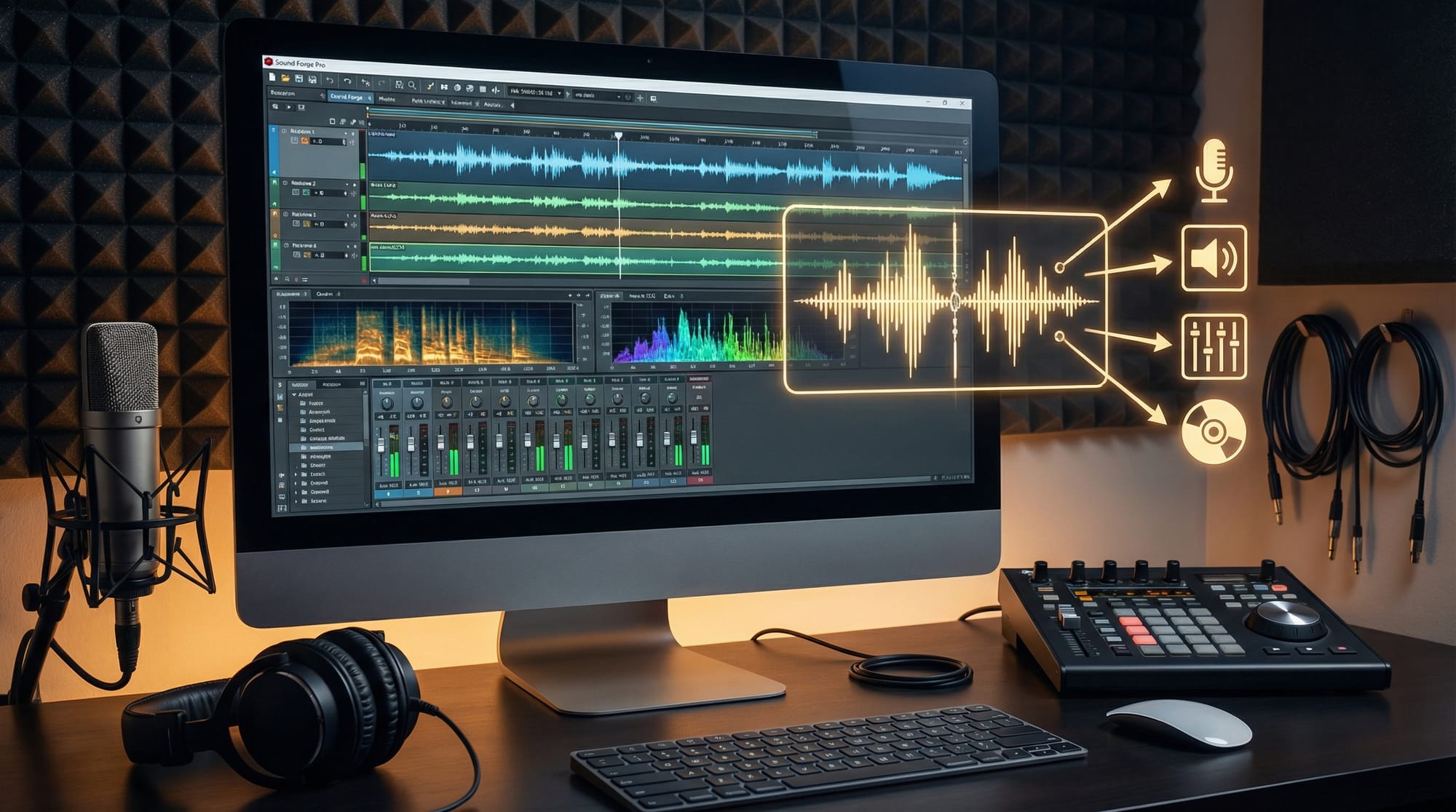
Sound Forge Pro is not a DAW. That's the first thing to get straight, because it's the source of more confused purchases than anything else about this software. You cannot arrange a multitrack session in it. There's no timeline where you layer stems, no mixer channel strip per instrument, no MIDI sequencing. If you open it expecting Reaper or Ableton, you'll be confused within five minutes.
What it does is work on individual audio files — and it does that with a level of precision that dedicated DAWs generally don't match. You can zoom in to the sample level and make edits that would be clumsy or impossible in most multitrack environments. That's the actual design: a specialist tool for the work that happens after your mix is done, or for audio that never went near a multitrack session to begin with.
The typical use cases: mastering a stereo file to streaming loudness standards, cleaning noise and clicks out of a recording, restoring old vinyl or archival audio, editing and normalizing podcast episodes, post-production cleanup on dialogue or voice-over. That's what Sound Forge Pro was built for in 1992, and that's still what it's best at in 2026.
The Boris FX Acquisition: What Changes and What Doesn't
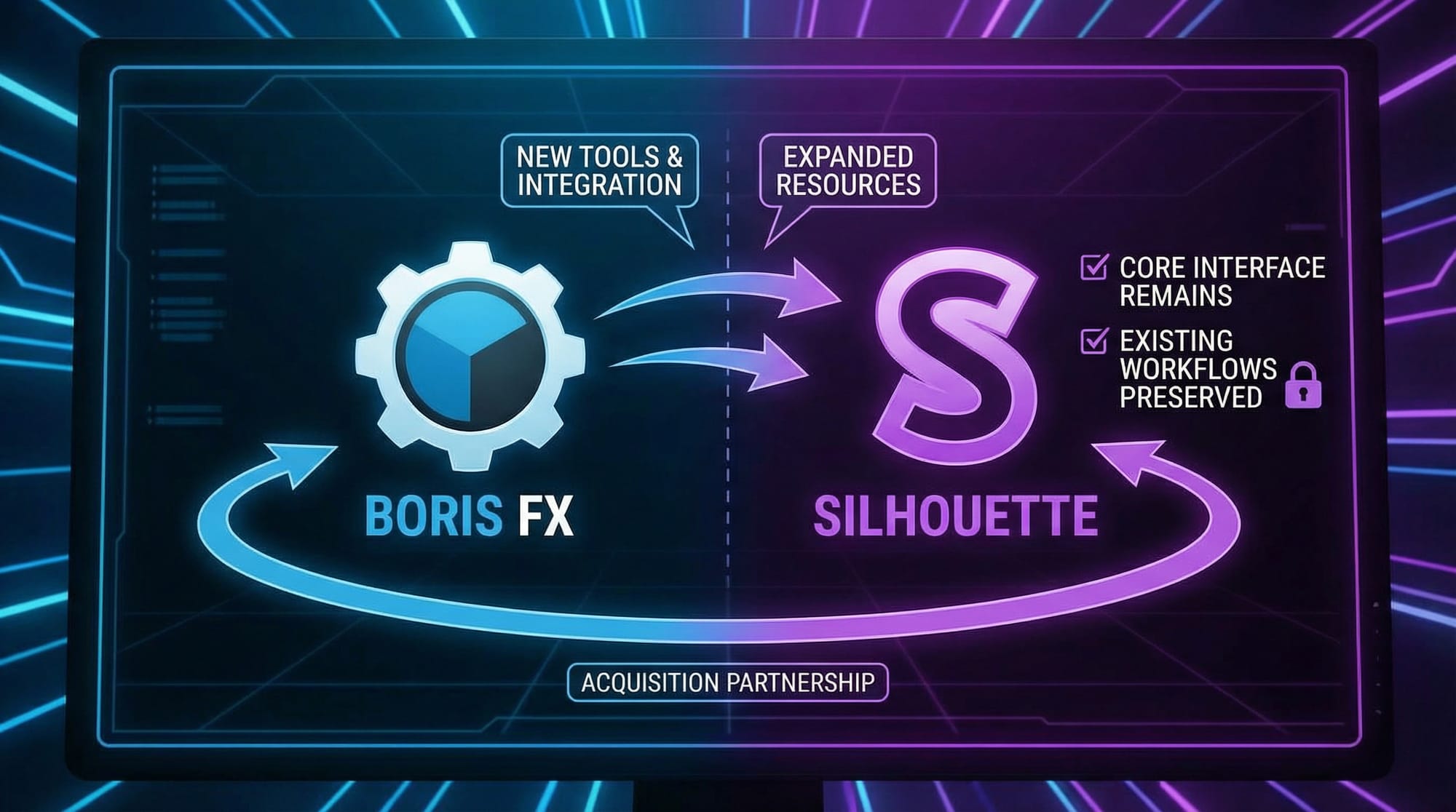
Boris FX announced the purchase on March 30, 2026. The development teams in Madison, Wisconsin and Germany are staying — Boris FX confirmed this explicitly. The institutional knowledge of a tool this specialized lives in the people who've been maintaining it, not in the brand name on the box.
What's different is where the software goes from here. Boris FX has a clear pattern with acquisitions: they integrate their own technology into the products they buy. Vegas Pro 2026 already arrived with Continuum titling tools and an updated AI depth model within the same week as the announcement. Sound Forge is next in line for integration with Boris FX's AI audio stack — specifically CrumplePop, a set of AI-driven audio cleanup plugins Boris FX acquired separately.
In practice, that could mean AI noise reduction and stem separation built into Sound Forge Pro without needing to open a separate application. The iZotope DSP modules that have shipped with Sound Forge Pro since version 11 are good, but they're not AI-driven. CrumplePop's tools work differently and in some cases more transparently on dialogue and voice content. Whether Boris FX delivers on this in 2026 or 2027 is unknown — the acquisition announcement didn't include a roadmap for Sound Forge specifically.
For now, what you're buying is the same audio editing software for Windows that shipped as Sound Forge Pro 18 under MAGIX. The internals haven't changed. The branding has.
What Sound Forge Pro Does Well
Waveform editing at the sample level
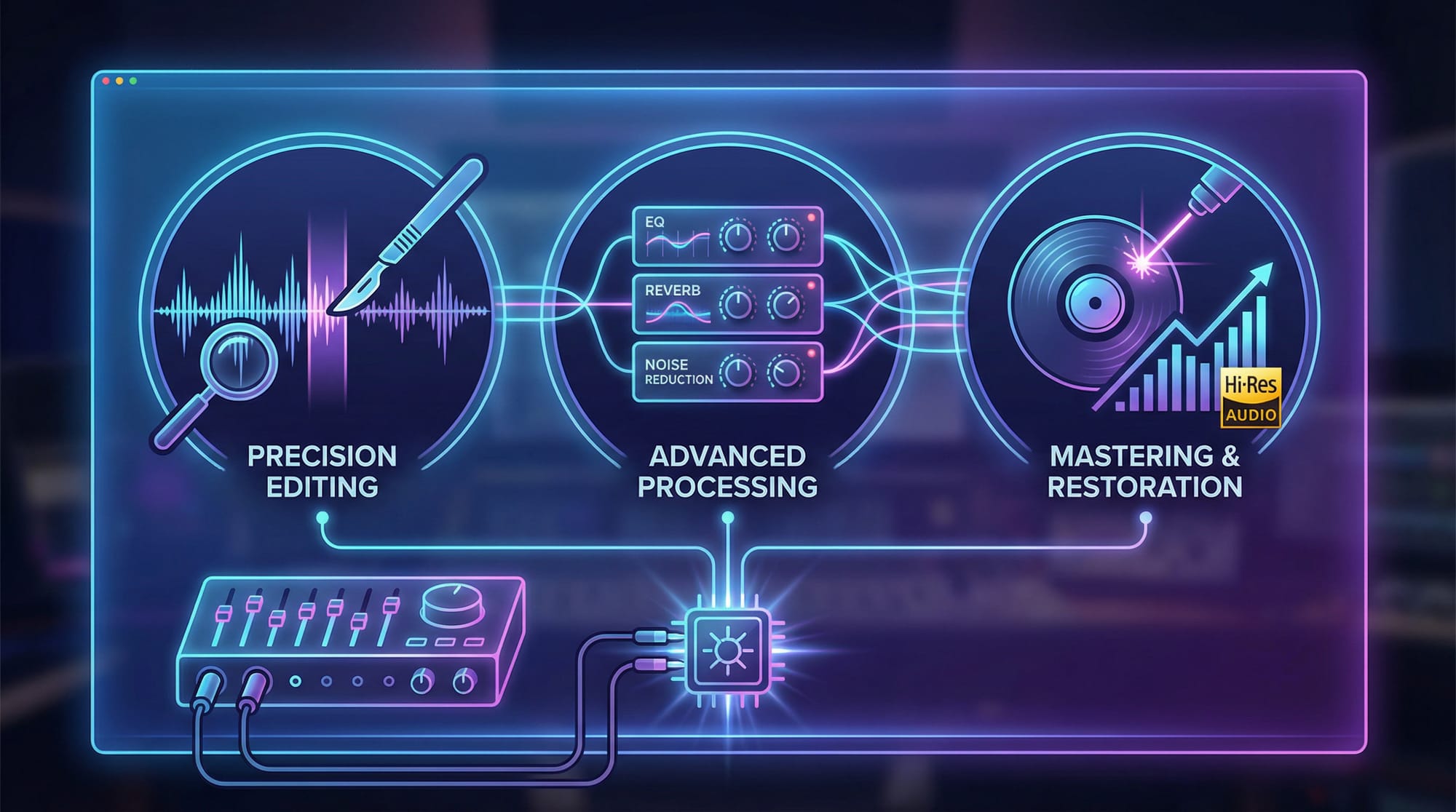
This is where Sound Forge Pro earns its place. The editing resolution goes down to individual samples — you can find and fix a single clipped transient, remove a breath that lands between two words, or adjust a zero-crossing to prevent a click on an edit point. Most DAWs let you do some version of this, but the interface in Sound Forge Pro is built around it rather than treating it as an edge case.
WaveColor is one of the less obvious features worth knowing about. It color-codes the waveform display based on pitch, character, and saturation levels — so problem areas like distortion or heavy sibilance show up visually before you've listened to them. It sounds like a gimmick until you've used it on a dense dialogue edit and spotted three clipping issues in under a minute that you'd have otherwise found by ear.
Noise reduction and audio restoration
The restoration suite runs on iZotope DSP and covers the four problems that come up most often: broadband noise reduction, click and pop removal, clipping repair, and de-essing for harsh high frequencies. These are the same algorithms iZotope ships in its standalone products, licensed into Sound Forge Pro as an integrated suite rather than a separate application you have to round-trip through.
For practical work: a 10-minute voice-over recorded in a room with audible air conditioning typically cleans up in two passes — noise print capture, then reduction — in under three minutes including export. Not every recording is that straightforward, but the workflow is fast when the problem is common.
Old vinyl restoration is another area where this toolset earns its keep. Click removal on a 45-minute album rip with automatic detection runs as a batch job while you're doing something else.
Mastering and loudness metering to streaming standards
The mastering chain covers EQ, multi-band compression, the Wave Hammer peak limiter, and loudness metering that reads LUFS, True Peak, and RMS simultaneously. For delivering to Spotify's -14 LUFS target or Apple Music's -16 LUFS, the metering is accurate and the limiting is clean at moderate amounts of gain reduction.
CALM Act compliance metering is also included — relevant if you're delivering audio for broadcast television, where FCC rules require commercials to match program loudness levels under the ATSC A/85 standard. Not everyone needs this, but for broadcast post-production work, having it built into the metering chain saves a separate step.
It's not as deep as iZotope Ozone for mastering. There's no mid-side processing, no imager, no reference track comparison. But for a single-application workflow where you're finishing a podcast episode or a short-form music release without wanting to open a dedicated mastering tool, it covers what most projects actually need.
Recording up to 32 channels at 192 kHz
Sound Forge Pro records up to 32 simultaneous channels at up to 64-bit/192 kHz sample rate. ASIO driver support keeps monitoring latency low enough for live tracking. The recording interface is more direct than what you get inside a typical DAW — fewer project management layers between you and the record button, which matters when you're capturing a take and don't want to navigate around timeline structures designed for a different workflow.
Batch processing across hundreds of files
The batch processor handles chains of operations — normalize, noise reduce, format convert, rename, export — across hundreds of files in one run. For podcast producers with a weekly backlog, or anyone archiving old recordings to a modern format, this feature alone can justify the price. Running de-noise and loudness normalization on 150 files while you're away from the computer is a different experience than doing it manually one file at a time.
What Sound Forge Pro Doesn't Do Well
No multitrack arrangement
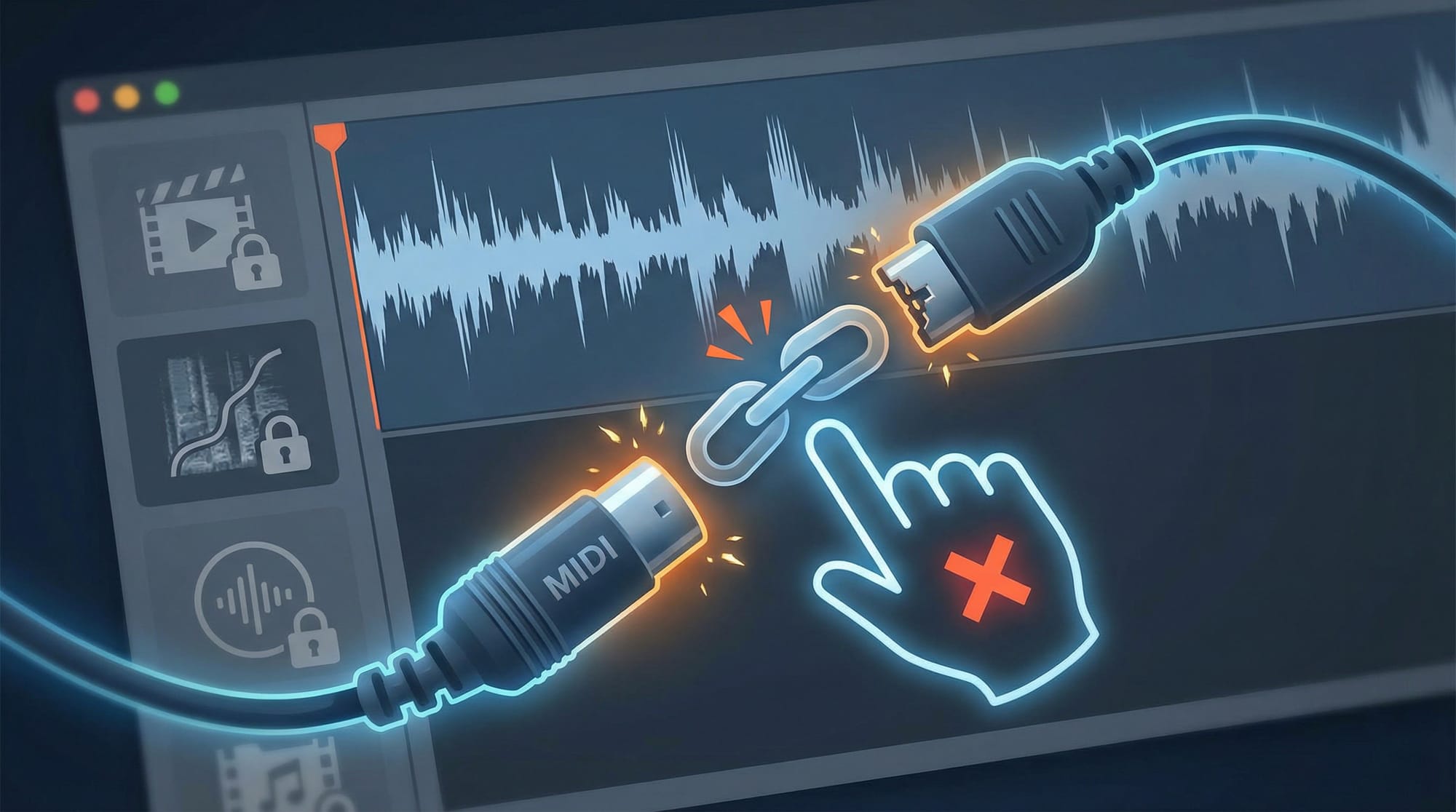
Worth repeating plainly: there is no multitrack arrangement in Sound Forge Pro. If you need to mix stems, build a song from individual tracks, or work across more than one audio file simultaneously, you need a different application. Sound Forge Pro is the tool you use after the mix, not during it.
No Mac version — and no timeline for one
Sound Forge Pro Mac was discontinued by MAGIX and Boris FX hasn't announced any plans to revive it. This is a real problem in 2026 — a large share of music producers and audio engineers work on Apple Silicon hardware. If you're on macOS, this software isn't an option, and there's no public timeline for when that might change. Adobe Audition 2026 (version 26.0) and iZotope RX 11 both run natively on Apple Silicon; Sound Forge Pro doesn't run at all.
Not the right entry point for beginners
The interface makes sense once you know it. Getting there takes longer than it should if you're new to dedicated audio editing software. The feature set is dense and the workflow assumes familiarity with concepts like noise prints, sample rates, dithering, and loudness metering. If you're recording your first podcast and want something you can learn in an afternoon, SOUND FORGE Audio Studio — the lighter version in the same product line — is the better starting point.
Pricing in 2026: Tiers, Perpetual License, and the Upgrade Window
Since the acquisition, Sound Forge pricing runs through the Boris FX webshop. Two tiers: Sound Forge and Sound Forge Plus. Both are available as annual subscriptions or perpetual licenses — Boris FX kept the perpetual option, which matters to users who had concerns about MAGIX's subscription direction in recent years.
Sound Forge Plus adds pitch correction tools, amp emulation plugins, and more capable reverb processing on top of the base version. If your work involves tuning vocals or tracking through amp simulations, Plus is the relevant tier. If you're doing restoration, mastering, and batch processing, the base version covers it.
Existing owners of any previous Sound Forge version — including Sound Forge Pro 18 under MAGIX — can upgrade at a single reduced price through December 5, 2026. Exact current prices aren't quoted here because they update; check the pricing page directly for what's live now.
A 30-day free trial with full access is available, no credit card required.
Should You Wait for the Boris FX Updates?
Boris FX moves quickly after acquisitions — Vegas Pro 2026 had new features the same week the deal closed. But a version of Sound Forge Pro with CrumplePop AI audio tools integrated hasn't shipped yet, and there's no announced release date. If AI-driven noise reduction is the main thing drawing you to the software, waiting three to six months to see what Boris FX ships makes sense.
If you need the audio editing software now for active production work, the current version handles everything it's always handled. The Boris FX updates are potential upside. They're not a reason to hold a running project.
Sound Forge Pro vs. Adobe Audition vs. iZotope RX 11
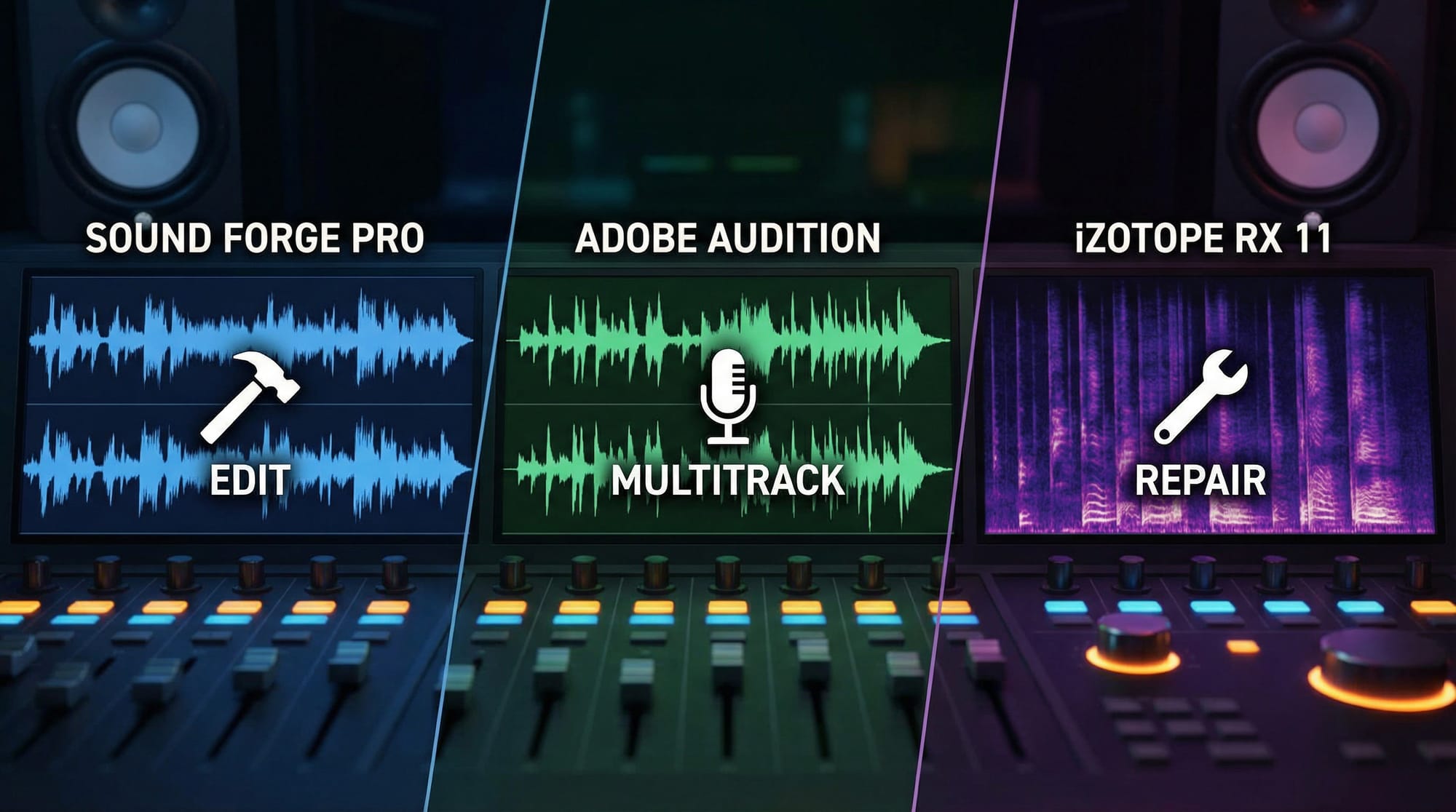
Adobe Audition 2026 (version 26.0, released January 2026) is both a multitrack editor and a waveform editor. If you're already paying for Creative Cloud at $22.99/month for the standalone plan, it makes sense to evaluate it first — but the multitrack environment adds overhead you don't need for pure restoration and mastering work. Sound Forge Pro is faster for single-file editing once you know the interface. Audition also requires a credit card for its free trial; Sound Forge Pro's 30-day trial doesn't.
iZotope RX 11 is the specialist tool for audio repair. Standard runs $399 at full price; Advanced runs $1,199. Its spectral repair, dialogue isolation, and Music Rebalance stem separation go further than what Sound Forge Pro's iZotope-licensed suite offers. If audio restoration is your entire job, RX is the more capable tool — but it doesn't include mastering, recording, or batch processing, so you'd need to pair it with other software to cover what Sound Forge Pro handles in one application.
Sound Forge Pro sits between them. More capable than Audition for waveform-level work, less deep than RX 11 for complex restoration, more complete than either for a workflow that covers recording through final delivery in a single application. Someone mastering podcast episodes has different needs than someone cleaning up archival film audio, and those two people will likely land on different tools.
The Bottom Line
Sound Forge Pro in 2026 is the same capable audio editing software for Windows it's been for years — now at a company with a stronger development track record than MAGIX had in its last few Sound Forge releases. The acquisition hasn't broken anything. The perpetual license is still available. Former MAGIX customers can upgrade at a reduced price through the end of 2026.
The case for buying it now is strongest for Windows users doing restoration, mastering, voice-over cleanup, or batch processing work who want one application instead of three. The case against is simple: Mac users have no version to run, and anyone who specifically wants the Boris FX AI audio features should wait and see what ships.
If either of those exceptions applies to you, the answer is obvious. If neither does, the current version of Sound Forge Pro does what it's designed to do, and the trajectory under Boris FX looks better than it has in a while.
Frequently Asked Questions
Who owns Sound Forge Pro in 2026?
Boris FX acquired Sound Forge Pro from MAGIX Software GmbH on March 30, 2026. The software is now sold through vegascreativesoftware.com, alongside Vegas Pro and Acid Pro.
Is Sound Forge Pro available for Mac in 2026?
No. MAGIX discontinued the Mac version before the acquisition, and Boris FX has not announced plans to release a macOS version. Sound Forge Pro is currently Windows-only.
Does Sound Forge Pro still offer a perpetual license?
Yes. Boris FX offers both annual subscriptions and perpetual licenses. Existing MAGIX customers with any previous Sound Forge version can upgrade at a reduced price through December 5, 2026.
Is Sound Forge Pro a DAW?
No. Sound Forge Pro is a single-file waveform editor for audio mastering, restoration, and editing. It does not support multitrack arrangement or MIDI sequencing. For full music production you need a separate DAW.
What is the difference between Sound Forge and Sound Forge Plus?
Sound Forge Plus adds pitch correction, amp emulation plugins, and more advanced reverb processing. The base version covers waveform editing, noise reduction, mastering, recording, and batch processing.
What was the last version under MAGIX?
Sound Forge Pro 18 was the final version released under MAGIX before Boris FX completed the acquisition in March 2026.
Can I try Sound Forge Pro for free?
Yes. A 30-day free trial with full functionality is available at vegascreativesoftware.com. No credit card is required.